-
- No Comments
- May 23, 2026

Upwork WordPress Developers vs. Dedicated WordPress Agencies
If you need WordPress work done, you basically have two options. You can hire someone on Upwork, or you can work with a dedicated WordPress agency. Both can deliver results. But the experience, the risk, and the outcome are very different. This post breaks down exactly what separates the two, so you can make the right call for your project or your agency.
The Short Answer
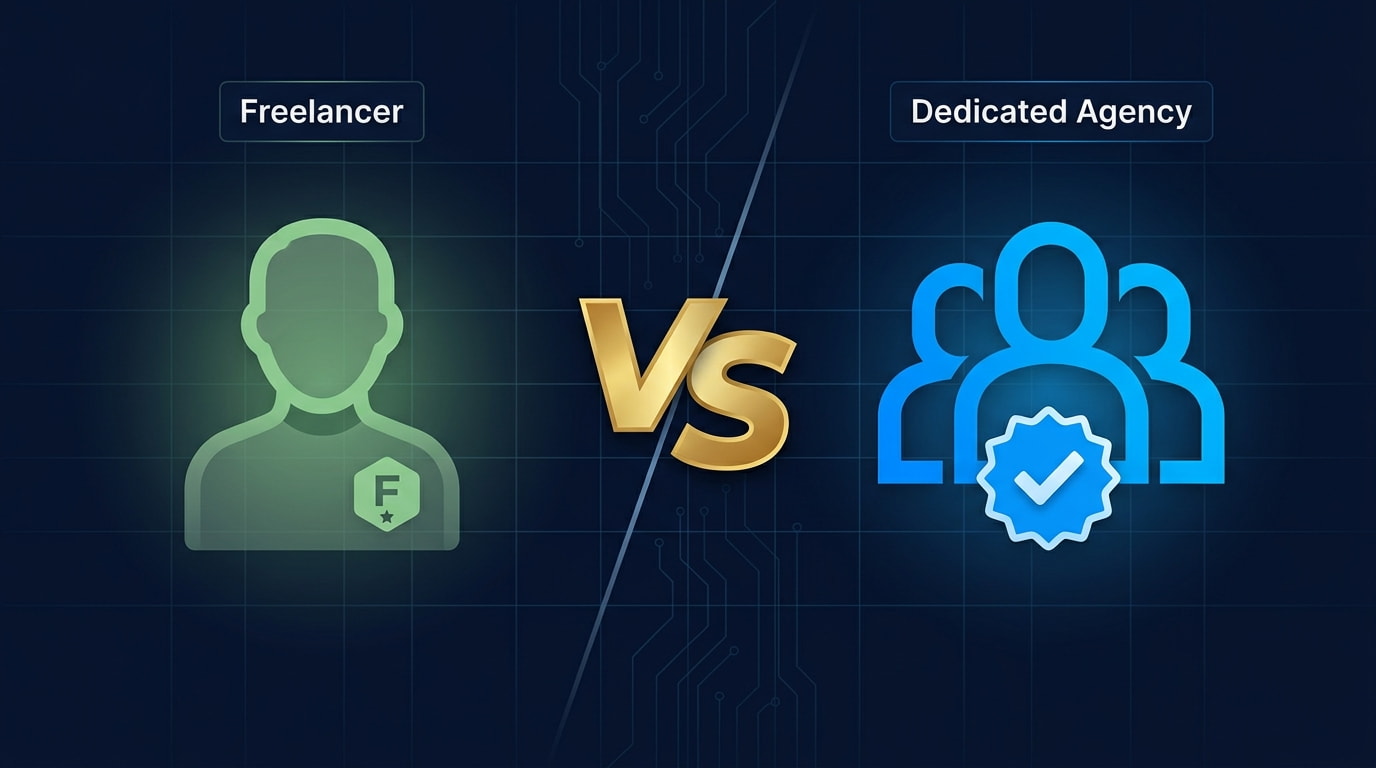
Upwork gives you access to individuals. A dedicated agency gives you access to a team. That single difference creates a ripple effect across quality, reliability, communication, speed, and cost over time. Hiring on Upwork can work brilliantly for small, well-defined tasks. For anything that requires consistency, accountability, and scale, a dedicated agency almost always wins.
How Hiring on Upwork Actually Works
You post a job. Dozens of freelancers apply. You review profiles, check ratings, read reviews, and pick someone. Then you hope they are available, that their skills match what their profile says, that they communicate clearly, and that they deliver on time.
Sometimes that works out perfectly. Sometimes it does not.
The core problem with Upwork is that you are betting on an individual. That individual might be excellent. They might also disappear mid-project, take on too many clients at once, hit a technical wall they did not tell you about, or simply be better at winning jobs than completing them.
Upwork also has a learning curve for each new hire. You have to explain your project, your standards, your preferred tools, and your communication style every single time. Even if the person is skilled, there is a ramp-up period. For agencies doing this repeatedly, that hidden time cost adds up fast.
How a Dedicated WordPress Agency Works
A dedicated agency brings a structured team to your project. There is a developer, often more than one. There is usually a project manager. There are QA processes. There are established workflows. You are not betting on one person staying available and staying focused. You are working with a system.
When you work with a white label WordPress agency like ThemeLocation, you bring them a brief and they handle the rest. They ask the right questions, scope the work properly, assign the right developer for the project type, test everything before delivery, and communicate in your preferred tools.
You do not have to re-explain your standards every time because the agency has already learned how you work. That relationship compounds in value the longer you use it.
Quality: Individual Talent vs. Systematic Standards
Upwork quality varies wildly. A five-star rating on Upwork tells you the person was good enough for the last client. It does not tell you whether they follow WordPress coding standards, whether they test before deploying, or whether their code will still work after the next major WordPress update.
A good agency has internal quality controls. Code is reviewed before it ships. Updates are tested in staging environments. Sites are checked against performance benchmarks. That consistency is hard to replicate with individual freelancers because it depends entirely on the person’s own habits and discipline.
This does not mean every freelancer is low quality. There are excellent WordPress developers on Upwork. But finding them takes effort, and keeping them exclusive to your work is nearly impossible.
Reliability: The Risk Nobody Talks About
Here is a scenario every agency has experienced at least once. You hire a WordPress developer on Upwork for a project with a client deadline. Halfway through, the developer goes quiet. Messages are delayed. Then they mention they have taken on another project. Then they deliver late, or not at all.
Your client does not care about your freelancer problems. They care about their deadline.
Agencies do not disappear mid-project. They have multiple people who can pick up work if one developer is unavailable. They have contractual obligations and real business reputations to protect. The accountability structure is completely different.
Communication: Scattered vs. Structured
With Upwork freelancers, communication often lives inside the Upwork platform, in email threads, or in WhatsApp messages. There is rarely a structured update process. You chase for progress reports. You are not sure if work is happening until you ask.
A good agency runs communication through whatever tools you already use, whether that is Slack, Asana, Trello, or ClickUp. Updates are proactive. Milestones are clearly defined. You always know where the project stands without having to ask.
Cost: Cheaper Up Front vs. Cheaper Over Time
This is where Upwork looks most attractive. A WordPress freelancer on Upwork might charge $15 to $40 per hour depending on their location and experience level. An agency typically charges more per hour or has higher minimum project values.
But that comparison is only accurate if you look at the transaction in isolation.
Here is what the Upwork cost comparison misses:
- Time spent reviewing dozens of applications and interviewing candidates
- Time spent onboarding each new freelancer to your standards
- Cost of fixing work that was done incorrectly or needs revision
- Cost of missed deadlines and client trust damage
- Time managing communication and chasing updates
- Re-hiring cost if the freelancer is unavailable for your next project
When you add all of that up, a dedicated agency often costs less over a full year than the cycle of finding, hiring, onboarding, and managing individual Upwork freelancers.
Scalability: One Person vs. A Team
If your project grows or your client adds scope halfway through, a freelancer can only do so much. They have one set of hands, one schedule, and limited bandwidth. If they are at capacity, your project waits.
An agency can scale. They can put two developers on a project when a deadline moves. They can have a designer working in parallel with a backend developer. They can absorb extra scope without grinding to a halt.
For agencies that have multiple client projects running simultaneously, this scalability is not a nice-to-have. It is essential.
White Label Capability: Only Agencies Offer This
If you are a marketing or design agency reselling WordPress development, Upwork freelancers present a practical problem. You cannot easily white label an individual. You have to manage them closely, make sure they never contact your clients directly, and hope they do not include their name in any file metadata or email footers.
A white label WordPress agency is built for this from the ground up. Your brand on everything. Their name nowhere. Signed NDAs before any work starts. No client contact unless you explicitly want it. The entire service is designed to make your agency look like it has a full development team in-house.
When Upwork Does Make Sense
To be fair, Upwork is genuinely useful in certain situations:
- Small, one-off tasks with very clear scope, such as fixing a single bug or making one design change
- When you have unlimited time to vet, onboard, and manage a developer
- When budget is the only priority and quality risk is acceptable
- When you need a very niche specialist for a short engagement
If you are doing a quick content edit or a minor CSS fix, posting on Upwork and paying a few dollars per hour makes complete sense. Nobody needs to hire an agency for that.
The Bottom Line
Upwork gives you access to individuals at a low hourly rate. A dedicated WordPress agency gives you access to a system: a team, a process, accountability, and the ability to scale. For one-off small tasks, Upwork can work. For anything involving client relationships, recurring work, white label delivery, or projects that matter to your business, a dedicated agency is worth the investment.
The question is not which one is cheaper per hour. The question is which one actually gets the job done reliably, on time, to a standard your clients will not complain about.